
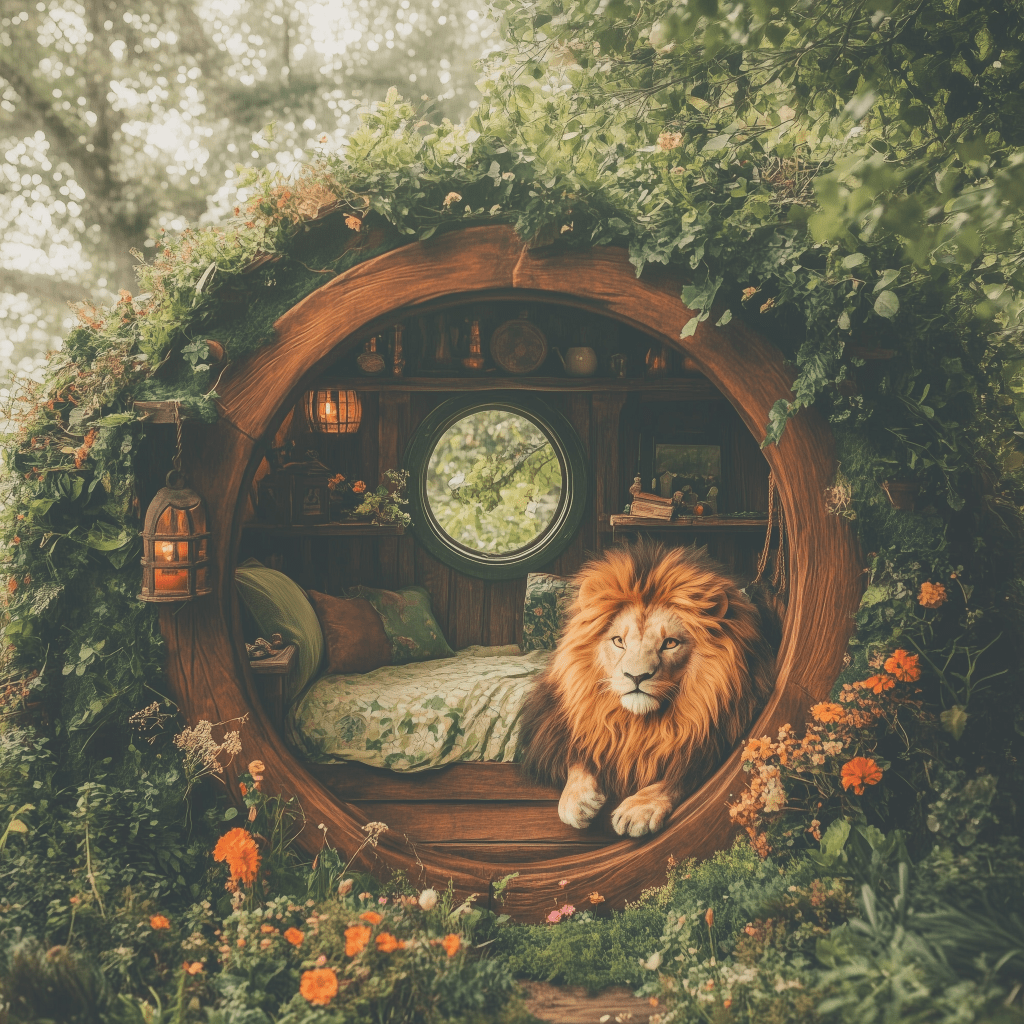
The following information is taken almost entirely from two great books: Bandersnatch: C.S. Lewis, J.R.R. Tolkien, and the Creative Collaboration of the Inklings by Diana Pavlac Glyer and Tolkien Dogmatics : Theology through Mythology with the Maker of Middle Earth by Austin M. Freeman.
C.S. Lewis turned away from Christianity in his teen years and had no plans of going back, believing religion to be ancient superstition. However, as he grew up, he met several intelligent men who were Christians and he also realized that his favorite authors believed in God. In 1930, he gave up his atheism, calling himself “the most dejected and reluctant convert in all England.” The following year, his friends J.R.R. Tolkien (whom Lewis called “Tollers”) and Hugo Dyson led him to Jesus.
Before his conversion, Lewis and Tolkien would hang out each week and converse. Their conversation focused on their writing projects, especially after Tolkien decided to share the mythology of Middle Earth that he had been working on. Over the course of 17 years, this gathering grew into 19 official members known as The Inklings, in which invited writers would read their drafts to one another and receive critique.
The Inkling’s Influence
Much of Lewis’ works did not fit Tolkien’s admittedly unusual taste and high standards. Tolkien rarely elaborated on his reasoning for not liking something, giving the impression that he was quite hard to please. For example, to one of Lewis’ books he remarked, “I began a commentary on it, but if finished it would not be publishable.”
Part of Tolkien’s trouble with Lewis’ writing was that it was religious. Tolkien felt this was inappropriate since Lewis was a literary scholar and not a part of the clergy. Perhaps this is why Tolkien was so embarrassed when Lewis dedicated his popular book, The Screwtape Letters, directly to him. The rest of his educated colleagues despised this book as well. “You don’t know how I’m hated,” poor Lewis confessed to a friend once.
Tolkien’s most famous opposition to Lewis’ works was The Chronicles of Narnia. Lewis read Tolkien the first three chapters of The Lion, The Witch, and the Wardrobe, to which Tolkien responded that it was “about as bad as can be” and “almost worthless.” Lewis was surprised and hurt. Had he not shared these chapters with another friend for their opinion, he may have never continued writing it. The friend told him it was “more than good,” and Lewis finished writing it over the next 20 days.
Many proposals have been made as to why Tolkien disliked Narnia so much. Some say he didn’t like the way he mixed mythologies together. Others think Tolkien may have been jealous since he resented Lewis for borrowing elements from his work from time to time. He may have also been jealous that Lewis wrote so much faster and fluently than Tolkien. But the only reason Tolkien ever explicitly stated was in a letter to a fan: “I am glad you have discovered Narnia. These stories are deservedly very popular; but since you ask if I like them I am afraid the answer is No. I do not like ‘allegory’, and least of all religious allegory of this kind. But that is a difference of taste which we both recognized and did not interfere with our friendship.” But despite this clear statement, it doesn’t quite line up as Tolkien used allegory in his fiction, non-fiction, and poetry. In the end, Tolkien was sad that he didn’t appreciate his friend’s work. Though he didn’t enjoy them, he eventually admitted that Narnia was “deservedly very popular,” and had it on his bookshelf for his granddaughter to read.
Of course, Tolkien faced his own criticisms for The Lord of the Rings. John Wain complained, “When Tolkien came through the door at a meeting of the Inklings with a bulging jacket pocket, I winced because I knew we were in for a slab of Gandalf and Bilbo Baggins and the rest of it. I wished him no harm, but would have preferred him to keep his daydreams within bounds and not inflict them on us.” Hugo Dyson, Tolkien’s friend who helped lead Lewis to Christ, hated it more than anyone else. Tolkien wouldn’t read it if Dyson were present and if Dyson showed up late and he was already reading it, he’d put it away. While reminiscing of his time in the Inklings, Tolkien’s son Christopher described such moments like this: Lewis would say, “‘Shut up Hugo. Come on Tollers.’ And The Lord of the Rings would begin with Hugo lying on the couch, and lolling and shouting and saying, ‘Oh God, no more Elves.’ The Inklings was a bit like that.”
Lewis once said that, “No one ever influenced Tolkien—you might as well try to influence a bandersnatch. We listened to his work, but could affect it only by encouragement. He has only two reactions to criticism; either he begins the whole work over again from the beginning or else takes no notice at all.” But that wasn’t entirely the case. Indeed, Lewis had a monumental impact on the story when Tolkien needed help to get The Lord of the Rings to move forward. He had written many opening chapters, but in the end, he continually got too hung up on the hobbits. Tolkien stated, “I am personally immensely amused by hobbits as such, and can contemplate them eating and making their rather fatuous jokes indefinitely; but I find that is not the case with even my most devoted ‘fans.’” He eventually met with Lewis to voice his frustration, and Lewis said something that changed The Lord of the Rings forever: “hobbits are only amusing when in unhobbitlike situations.”
This piece of advice pushed Tolkien in a new direction. His drafts began incorporating the Black Rider, as the sequel to The Hobbit grew much darker than his original fairytale for children. Due to the advice of the Inklings, the story was finally moving somewhere, whereas before, Tolkien would abandon his writing for long periods and put all of his attention on writing histories, genealogies, and made-up languages for his characters.
As they continued writing their works, Lewis and Tolkien occasionally tried to capture each other in their writings. The main character of Lewis’ sci-fi trilogy is a philologist (someone who studies languages) named Elwin Ransom. Elwin is old English for “elf-friend” and this character happened to embody quite a few of Tolkien’s opinions and ideas. Lewis noted him as “a fancy portrait of a man I know.” Tolkien, on the other hand, put a little bit of Lewis into his character Treebeard who often makes the noise, “Hrum, Hroom.” This noise was an allusion to capturing Lewis’ booming voice.
The Holy Spirit’s Influence
The Holy Spirit seemed to be at work in both Tolkien and Lewis’ work. Lewis described several of his fiction books as coming to him in something like visions. He said, “All of my seven Narnian books, and my three science-fiction books, began with seeing pictures in my head. At first they were not a story, just pictures. The Lion all began with a picture of a Faun carrying an umbrella and parcels in a snowy wood. This picture had been in my mind since I was about sixteen. Then one day, when I was about forty, I said to myself: ‘Let’s try to make a story about it.’ At first I had very little idea how the story would go. But then suddenly Aslan came bounding into it. I think I had been having a good many dreams of lions about that time. Apart from that, I don’t know where the Lion came from or why He came. But once He was there He pulled the whole story together, and soon He pulled the six other Narnian stories in after him.
If we attribute such visions to the Holy Spirit as I’m inclined to do, then we can see how Lewis and the Spirit co-labored together to bring about such cherished stories. Lewis puts it this way: “In a certain sense, I have never exactly ‘made’ a story. With me the process is much more like bird-watching than like either talking or building. I see pictures. Some of these pictures have a common flavour, almost a common smell, which groups them together. Keep quiet and watch and they will begin joining themselves up. If you were very lucky (I have never been as lucky as all that) a whole set might join themselves so consistently that there you had a complete story, without doing anything yourself. But more often (in my experience always) there are gaps. Then at last you have to do some deliberate inventing, have to contrive reasons why these characters should be in these various places doing these various things. I have no idea whether this is the usual way of writing stories, still less whether it is the best. It is the only one I know: images will always come first.”
In Tolkien’s work, the Holy Spirit (or should I say, “the Flame Imperishable”) seemed to inspire him in all kinds of ways. One day, while grading exams, he wrote down a sentence without clarity: “In a hole in the ground, there lived a hobbit.” In hindsight, Tolkien considered the moment to be inspired.
The Lord of the Rings is spiritually and theologically rich, perhaps beyond what he even knew while writing it. He could discern the differences between his inspired work and works of his own invention. He knew that some of his earlier tales belonged solely to him. He thought this was true with The Hobbit when he started it, but he began to sense a difference over time. “[A]lways I had the sense of recording what was already ‘there,’ somewhere: not of ‘inventing,’” he said.
Like Lewis, some of his stories came to him in fully-formed visions that felt independent of him. He couldn’t alter the visions but often felt that he had to morph his stories toward the visions. Sometimes, he wrote what he wanted, but other times, he waited for more information on what happened in the story so he could write it down. This influenced his writing in ways that even he didn’t want. For example, he never wanted Faramir in the story, (a very sad irony). Though the character of Faramir carried an intriguing spiritual work with him: Tolkien had a repetitive dream of a great wave towering above green fields, which he assigned to Faramir and wrote into the Numenorean story, causing the dream to finally stop repeating. Sometime after, his son Michael mentioned that he had the same dream, though they had never talked to each other about it.
Two years before Tolkien died, a strange thing happened. A man visited him and showed him some pictures he had that seemed to be of The Lord of the Rings, but they were drawn before the book was ever written. Confused by this situation, the man wondered if Tolkien had borrowed from the pictures. When he answered no, the man asked him if he thought he had written the story on his own. “Not anymore,” Tolkien concluded. He explained that he never felt like the story was solely written by him.
I can’t help but wonder if the Holy Spirit continues to protect this story in a way. While I understand that not everyone loves Rings of Power, season two of the show is perhaps the most accurate portrayal of the biblical concept of spiritual warfare that I have seen in any media. It baffles me that such rich Christian content could come from Amazon.
Inspiration comes from many places: ourselves, our friends, and sometimes the Holy Spirit. Myth has a way of becoming true in various ways. Indeed, it nearly sounds like a myth to imagine some of the greatest writers in the world smoking pipes in a bar while writing some of the world’s most famous stories together. Lord of the Rings is a book that we all treasure, and it seems to me to be one that the Holy Spirit treasures too. I have done deliverance sessions with three different people where the Holy Spirit has used visions and characters from The Lord of the Rings to illustrate something to them about how we are to remove their demons. May we, too, find inspiration in Tolkien’s mythology.

 Jamin Bradley
Leave a comment