
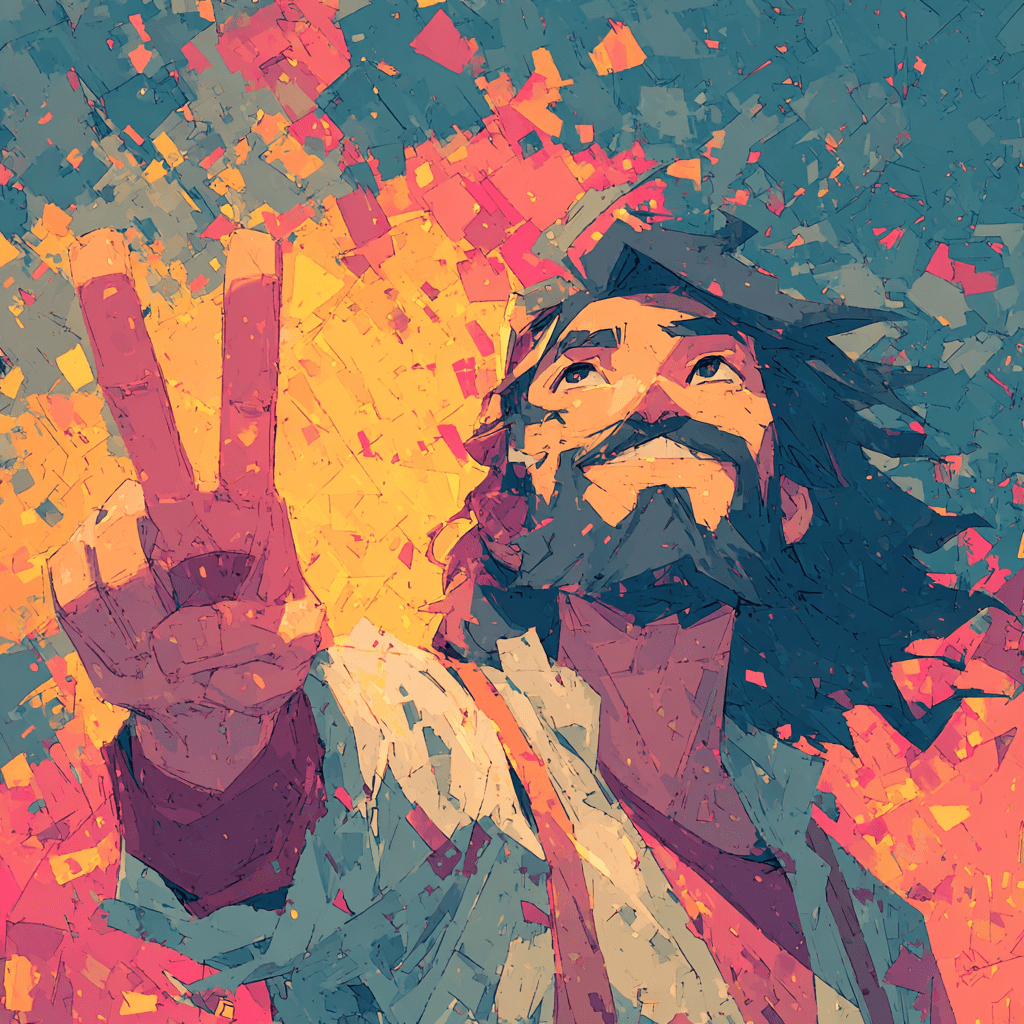
As I’ve stated many times over the years, I consider myself a Jesus-centric pacifist. This has long bothered many people who think I’m irrational and just lean into a few short Bible verses here and there. That being said, I offered my Facebook friends the chance to ask me their questions about my particular brand of pacifism, so I could give them a look at what I mean by it. Here is some of that exchange.
- What If I Believe in Pacifism But Don’t Know If I’d Stick to It?
- What if Killing Was the Only Way Out?
- Is Pacifism Just Complicity with the Status Quo?
- Pacifism and the Defense of Loved Ones
- “What Does ‘Blessed Are the Peacemakers’ Really Mean?”
- “What Does a ‘Renewed Mind’ Look Like in the Face of Violence?”
- Can You Be a Peacemaker and Still Train for Violence?
- When Violence Threatens the Church: How Should We Respond?
- Training for Spiritual Battle—But Not Physical?
- Is Pacifism Hard to Grasp Because We Assume Violence Is Inevitable?
What If I Believe in Pacifism But Don’t Know If I’d Stick to It?
I consider myself a “theoretical pacifist” – I believe non-violence is the right answer, but I can’t really be sure what I would do in a violent situation.
Yeah, we’re all “untested pacifists,” right?
I was taking someone through some inner healing who had eventually physically hurt their oppressor in order to get away from the danger. In no way do I think they sinned in that moment. They hadn’t renewed their mind to violence, they were simply trying to escape an impossible situation. Had they killed their oppressor, the conversation would have been different, but their relatively small act of physical aggression saved them in an incredibly dangerous moment.
The mind renewed to fear and violence doesn’t have space for anything other than the violence that comes from a life of fear. The mind that’s constantly trying to renew to Jesus makes space for other creative answers before it needs to settle for physical aggression in an impossible moment.
What if Killing Was the Only Way Out?
What would have the conversation looked like had your person had to kill the aggressor to get away?
That’s a bit of the difficulty with pacifistic conversations. People want to know the story based on how it didn’t go rather than how it did. That lets fear guide our theology rather than the Spirit. In reality, they didn’t have to kill them to live, so we’re imagining unreality.
But had it gone that direction (which it didn’t), I would have given the Holy Spirit ample time to speak to the participant and to me to figure out what inner healing should uniquely look like for them.
I don’t condemn people in inner healing. If I sensed the Spirit wanted them to work through taking someone’s life (which I assume he would want to in some way, even if just to deal with the guilt), then I would allow the Spirit to lead as he sees fit.
Is Pacifism Just Complicity with the Status Quo?
Yesterday my friend shared a post and I was curious about your thoughts on it. It said, “It is very easy to describe yourself as ‘nonviolent’ when in reality, you endorse the exploitation of people & habitual violence against them by their bosses, landlords, cops, etc. You call yourself a pacifist seeking change, but in reality, you are in fact bloodthirsty in your alignment with the status quo.
Your friend’s post raises some good points. But true Jesus shaped pacifism is meant to be a method that changes hearts and societies. If we’re practicing pacifism it in a way that has no impact on the lives around us, that’s just apathy. Pacifism isn’t “peace by disengagement”—it’s a tool used to correct the kind of issues your friend mentioned and bring peace into those areas of society.
Pacifism and the Defense of Loved Ones
Would you use violence defensively to protect your wife/kids if de-escalation didn’t work?
If my aggression wasn’t aimed at killing and I had no possible peaceful scenario left, then I imagine I’d show some physical aggression.
The difficulty is this: instead of renewing our minds to peace and peacemaking right now, we tend to renew our minds to the kind of violence we would use in the hardest scenarios we can think of that are based around our greatest fears, causing us not to renew our minds to fruit of peace at all.
While I realize others do not have the same story as me, I have no history of my family be held hostage and me having to be a superhero to save them. I also do not foresee this happening to me in the future either. If I make this fear the focal point of my pacifism and peacemaking, then my ideology and theology grows around my fear instead of the teachings of Jesus. In my college class on war and peace, people often created a theology of war based around the scenario of someone (or sometimes specifically Hitler for some reason) breaking into your home. Fear and what-if’s is not a good way to do theology.
When I first became a pacifist, I spent a lot of time daydreaming all the ways I might address such a situation in a way that felt more like Christ. By doing that, I was renewing my mind toward peace instead of violence. And when we do that, violence does not become our first resort to a difficult situation.
“What Does ‘Blessed Are the Peacemakers’ Really Mean?”
How do you interpret “pacemakers” as a ‘blessed be’? How do you explain Jesus’ reaction to the temple’s exploitation and commercialization?
“Blessed are the peacemakers, for they are the sons of God.”
A few things to note on this beatitude:
1. According to Tim Mackie at the Bible Project, “Blessed” might be better interpreted as “the good life.”
2. Why is peacemaking the good life? Perhaps because by being peacemakers, we are being brought into God’s heavenly family. “Sons of God” is a term in the Old Testament for the spiritual beings of heaven that are a part of God’s divine family.
3. Jesus is not implying that peacemaking is peaceful. Part of the reason you should be happy that you’ll receive a reward for peacemaking is because of how hard and unpeaceful it is. Ironic, right? You have to enter into a tense situation and try to bring hateful groups together by using the peaceful tactics of Jesus, which is best embodied as self-sacrificial love.
When Jesus arrives at his Father’s sacred home, it’s as though the hearts of all the prophets rise up in him as the prophet of his prophets. He called them a den of robbers because they were perpetuating injustice. As Nicholas Perrin writes in his book “Jesus the Temple:”
“By charging the temple elite with being ‘a den of robbers’ in the Jeremiah-esque sense, Jesus is ineluctably speaking out on behalf of the human wreckage left in the wake of this fiscal abuse, in this case those who would feel the heaviest brunt of their maladministration, the very poor.“
Peacemaking is especially about caring for and advocating for the poor and marginalized, and Jesus’ prophetic anger turned into a prophetic demonstration to do just that.
“What Does a ‘Renewed Mind’ Look Like in the Face of Violence?”
I’d like to hear more about the “renewed mind” you speak of. Could you maybe contrast what you think the “old” mind looks like when it is confronted with violence, oppression, insult, etc.?
Theologian Derek Flood has some great thoughts on the old mind as it’s seen in neuroscience:
“When we are triggered in an argument, feeling flooded and emotionally threatened, this activates the amygdala, which is the part of the brain involved in the processing of raw emotions such as anger and fear. The amygdala is essentially the brain’s watchtower, and when it is fired up in alarm mode, it sends out neurochemicals which effectively shut down the prefrontal cortex. The prefrontal cortex is the part of your brain associated with things like relational connection, empathy, impulse control, self-reflection, moral judgement and conscience — in short, the part of your brain in charge of what we might call the social-self.“
So how do we live by the new mind of the Spirit that wants to teach us to lean into love, joy, peace, patience, kindness, goodness, faithfulness, gentleness, and self-control, which the old mind wants to completely disregard? Flood gives two points:
“The first step is to recognize what is going on in our bodies. The part of our brain in charge of making good judgments has been temporarily shut down by our amygdala … This brings us to the second step: We need to have the maturity and humility to recognize that because we are emotionally triggered, we may need to allow time for our social brain to come back online.“
By practicing peace in difficult situations, we can grow in self control and retrain ourselves to live by the Spirit. It takes time and energy, but even daydreaming into peace in the here and now helps us to react differently when we actually face a threat.
Can You Be a Peacemaker and Still Train for Violence?
I find this fascinating because I desire peace with my whole heart, but in my heart I feel the need to train to be ready for violence in case it is visited on my family. Never to seek it out. It’s the classic “if you’re not capable of violence, you aren’t peaceful, you’re harmless,” mentality. I’ve never known if that’s entirely right. If that makes sense. As a peacemaker, wouldn’t it make sense to have the ability to reclaim your peace if it is taken from you? I have no solid stance on this topic as I haven’t done enough study.
I know there are many different forms of fighting, some of which may be more innocent than others. For me personally, training for any possible future violence I could encounter is me renewing my mind to people as enemies who may need to be violently opposed by me, rather than preemptively renewing my mind to Christ, peace, and self-sacrificial love.
How might I renew my mind to Jesus who took on the cross to save even his enemies? I find that training to hurt others is antithetical to this goal, so I stay away from it.
(I say this while recognizing there’s plenty of violence in my video games and movies trying to renew my mind elsewhere)
When Violence Threatens the Church: How Should We Respond?
I’m assuming you’ve already seen the news on a gunman who had several different guns and loads of ammunition and targeted a church in Wayne, MI? It’s made me rethink what my beliefs are on killing another human being. I’d never want to… but if it came to saving hundreds of people, or the church… idk? I don’t think I would still, or if I even could do so, but I don’t necessarily think it’s wrong. I think the man who rammed the guy with his truck did the right thing by stopping the gunman and injuring him enough to delay the attack, and allow some time to get officers there to do their jobs. I’m curious to hear your thoughts on the event. What could’ve gone better? What would you have done if you were in their shoes? I think preparing is important, because I don’t think God would want us to just be sitting ducks, or freeze in this situation.
After a massacre at Dunblane Primary School in 1996, Scotland and much of the UK just outlawed guns in order to ensure that such a horrible thing never happened again. America has had such atrocities happen over and over and over again because we continue to renew our minds to violence and the access of weapons to bolster our fears instead of trying to cultivate something different.
I know people are always going to do what they can to stop a shooter if a crazy situation happens. I don’t know that a shooter has to be killed to stop them, but I recognize I wasn’t in the high stakes scenario to make a judgment call.
Regardless, I’m not the kind of person to train people to go to church with fear, or bring guns to protect themselves just in case, or hire security that will shoot our enemies. Such things feel contrary to the mind of Christ for me.
I recognize I am more concerned with a shooter hurting my congregants than I am with them hurting me, as I would hope to personally find the courage of a more creative or self-sacrificial way of love forward.
I realize such input feels frivolous in light of something that just happened yesterday and was very real. I just can’t advocate for a church that’s actively training to kill its enemies.
There’s an old illustration of people jumping in a river to save babies floating down it. Eventually someone decides instead to go up the river to figure out why babies are being put in the river in the first place. I wish we had the political audacity other countries have had to deal with the guns rather than the massacres flowing down the river.
There are many intense stories of Christian groups that have undergone the horrors of such things and moved forward with peaceful tactics like forgiveness and blessing the families of their enemies.
Again, how might we pursue the mind of Christ in all things rather than a mind of fear. Easier said than done, I know.
Training for Spiritual Battle—But Not Physical?
I do, however, believe that we should “be on guard” not just in our hearts and in spirit, but in person as well. Not fearing… just being watchful, vigilant, and alert. I think you believe in training yourself up spiritually for the enemy, right? Why do you draw the line at physical?
As I’ve mentioned in our spiritual warfare podcast, I’ve learned to not pursue violence or hate when removing demons. The classic rule I give people is “don’t become a demon to remove a demon.”
Paul reminds us that we don’t wrestle with humans, but with demons. How often do we allow ourselves to demonize others rather than look at them with the love of Jesus and separate them from the demons they face?
So I’m not very violent in the spiritual realm, but I especially draw the line at the physical realm because Jesus told us to love everyone including our enemies, and as my professor used to say, “You can’t love someone with a shotgun.” Jesus died for us while we were still his enemies, so we need to figure out how to take up our crosses and follow him. Likewise, Revelation considers martyrdom to be a form of conquering the enemy, because the cross always implodes on Satan. Self-sacrificial love is the one thing that Satan cannot seem to figure out how to beat. And because he loves to steal, kill, and destroy, self-sacrificial love has a constant way of backfiring on him when we choose it.
I had a dream a few weeks ago that was stuck in a loop. I had to keep facing this demon of sorts and I kept fighting for myself. But when I finally stretched my arms out in the shape of a cross and didn’t retaliate, it killed me and lost at the same time. We don’t hear enough stories where suffering leads to victory because few ever choose a way different than violence. Few ever choose to imagine how a loving scenario could lead elsewhere.
When an angry spouse came into my bishop’s church and aimed a gun at him, the bishop just looked at him and said, “Really?” The man instantly had a change of heart, put the gun down and said, “No, I need Jesus.”
Do we dare to imagine a different way?
Is Pacifism Hard to Grasp Because We Assume Violence Is Inevitable?
Noticing a theme in the comments that reminds me of how people engage with anti-capitalism: they tend to frame questions using assumptions that only exist within the current system. Do you find that people struggle to understand pacifism because they imagine it within the framework of violence we live in now, rather than as a vision meant to replace that framework entirely?
That’s a solid point.
Perhaps another way to say it or something to add onto it: we will create the future that we decide to lean into and cultivate in the here and now. So long as we renew ourselves to the old framework and way of thinking, we create the environment needed for the sickness to continue surviving. Those who dare to dream of a different world try to come up with ideas to create that world as they slowly usher it into existence.
I get that violence will always exist, for all humans are born with fists. But it does not need to exist at the level that it does and justice work can help a different world break through as we as a community also train ourselves to think differently.
 Jamin Bradley
Leave a comment