
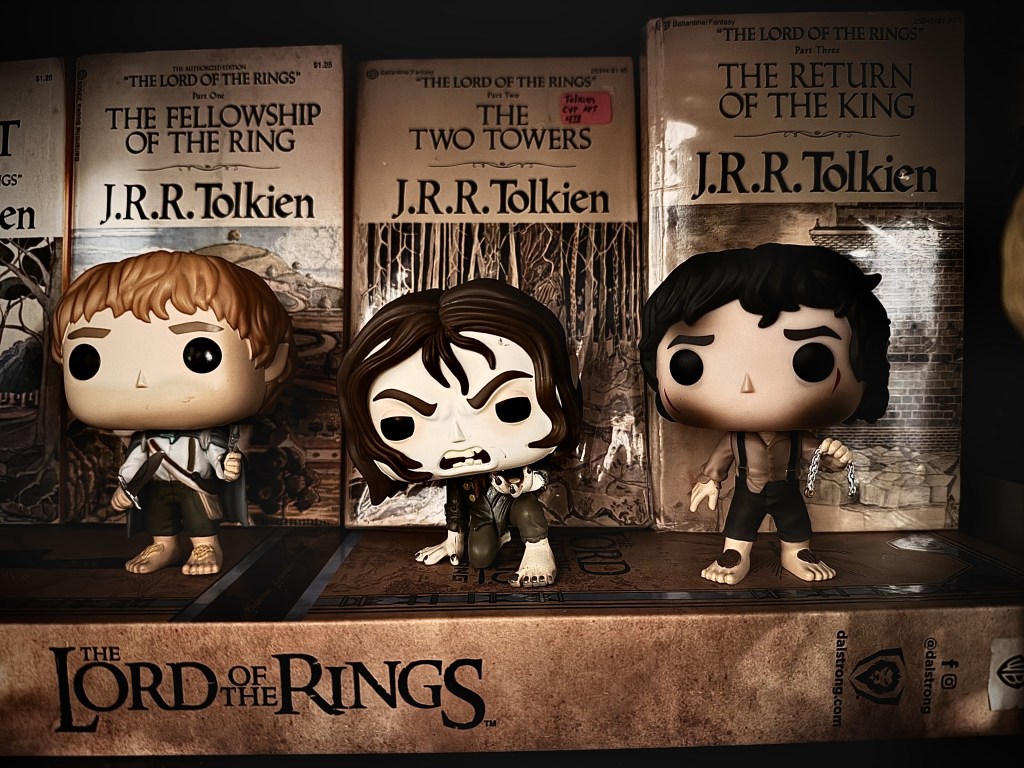
One of the theological themes that I see Tolkien consistently interweaving throughout The Lord of the Rings is God’s navigation of free will, and I sense that Gollum’s story is one of the chief illustrations of this. Right at the beginning of the trilogy, Gandalf teaches Frodo a lesson that revolutionizes the hobbit’s thinking all the way to the closing pages:
“For even the very wise cannot see all ends. I have not much hope that Gollum can be cured before he dies, but there is a chance of it. And he is bound up with the fate of the Ring. My heart tells me that he has some part to play yet, for good or ill, before the end…”
For some, this is no more than Tolkien foreshadowing the absolute ending of his story. For me, it illustrates a God who sees numerous endings of which have yet to be chosen. Perhaps Gollum will revert to Sméagol, and speak sense into Frodo in the final moments of his mission. Perhaps Gollum will heal and walk away from the situation entirely as Frodo bears his mission without fail.
Whatever options existed, we know the story only as it is, and not as it could have been: Like Pharaoh, Gollum was turned over to the weight of his sin, his hardened heart, and his quest for power—all of which brought about his downfall and Middle Earth’s victory. Though I don’t feel this was Gollum’s destiny at the time Gandalf spoke into it, it was one of the possibilities being worked out within—to use Galadriel’s words—the Quest that stood “upon the edge of a knife.”
But why didn’t Gollum get one of the better theorized futures?
While most recognize Samwise Gamgee as the hero of the story (and he is), our spiritual lives would do well to be convicted by his failings. Throughout the books, Sam does not work overly hard to practice any grace toward Gollum. For example, there is a moment where Gollum appears as “an old weary hobbit, shrunken by the years that had carried him far beyond his time, beyond friends and kin, and the fields and streams of youth, an old starved pitiable thing.” In this semi-tender moment, Gollum nervously reaches out to touch Frodo’s knee in a gentle and kind way. Sam awoke to the moment and called him names, causing Gollum to harden back up. Commenting on this exact moment in one of his letters, Tolkien shows exactly what I mean to illustrate:
Sam was cocksure, and deep down a little conceited; but his conceit had been transformed by his devotion to Frodo. … In any case it prevented him from fully understanding the master that he loved, and from following him in his gradual education to the nobility of service to the unlovable and of perception of damaged good in the corrupt. … If he had understood better what was going on between Frodo and Gollum, things might have turned out differently in the end. For me perhaps the most tragic moment in the Tale comes … when Sam fails to note the complete change in Gollum’s tone and aspect. … His repentance is blighted and all Frodo’s pity is … wasted. Shelob’s lair became inevitable.
As a deliverance minister, I think the movies amplify this dynamic between Gollum, Sam, and Frodo even better. Whether the screenwriters intended it to be a deliverance or not, at one point in the movies Sméagol renounces Gollum’s lies and casts him out. A new path is formed in this moment. But when Sam later reinforces Gollum’s old lies, the demon returns, making his life worse than it was before (Matthew 12:43–45).
The story of Gollum invites us to reflect on both ourselves and the troubled people in our lives. Do we have the space to hold out mercy and understanding for others like Frodo did in hopes to tell a better story? or do we resort to name-calling and condemnation, prophesying broken endings over others with our words and actions?
Sam is the hero, but he may not have needed to be if his imagination allowed for the kind of ending that only enemy-love can create.


Leave a Reply