
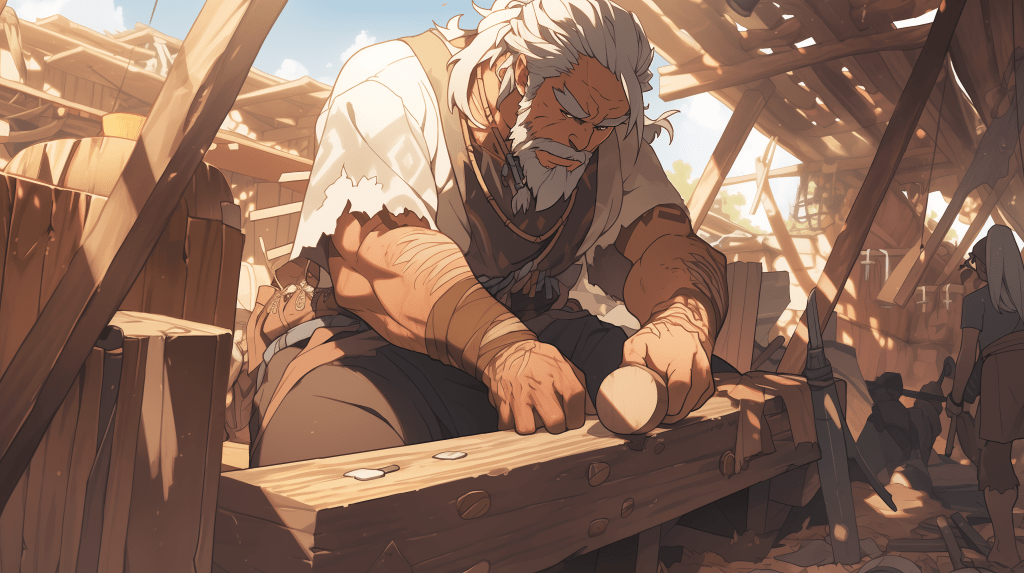
At Nerd Church we played a game in which we had to build a society in a fictional world and see how long we could get it to last before it caved under the weight of its social problems. The scenario I offered was a world in which angels and humans procreated and gave birth to giants. Everyone laughed, recognizing that I was once again bringing up the Nephilim. Classic Jamin.
Our communal imagination quickly came to life as we added details to our society. What kind of technologies did they have? Was there any sense of magic in this world, given that the giants had angels for parents? If the giants were conceived out of rebellion against God, were they raised to be rebellious against God? These giants would likely try to rule over humans and succeed, so what kind of society did they build? What kind of priorities did the giants have? Did their angelic parents stay on earth and live and rule from there, or did they return to Heaven?
Much of our biblical understanding is stifled by our unwillingness to wonder and our inability to put ourselves in the shoes of Bible characters. And even when we do wonder, we often bring so much of our modern context to the story that we don’t always get the right glimpse. For example, I’ve seen several movies that imagine what it’d be like if God told someone to build an ark today. The sociology imagined is the same as we hear preached at church: Everyone would have laughed at Noah, especially since so many people don’t believe God is real.
But that’s not Noah’s context. Remember, his society was connected to rebellious angels who lived in God’s presence. Those angels would have known that the society being built on earth was the complete opposite of what God wanted because they knew God and his character well. Add to this that they knew they had committed a grave sin in creating the giants. With this in mind, we can likely assume that these angels were a bit spooked when the only righteous guy in town was suddenly hearing words from God about a coming judgment.
Though 2 Peter 2:4 and Jude 6 tell us that these specific angels were locked up in Tartarus for their sins, which was a prison of sorts within the underworld. Depending on the timing of when this happened, they may not have been able to warn their giant-children to take Noah seriously. But perhaps they raised their kids to be aware of God, since they knew they were on his bad side.
Darren Aronofsky’s 2014 movie Noah does a much better job of practicing this kind of biblical imagination. Sure, he might have turned the giants into rock monsters and made them good guys who helped to build the ark, but he still engages our biblical imagination. He asks what an ancient corrupt society might look like and what kinds of technology, magic, and spirituality might have been practiced before the apocalypse hit. He also does a spectacular job at trying to get into the mind of a man who just saw the world end and what kinds of crazy things he might be thinking. Can we count any of his suggestions as biblical canon? No. But this practice of biblical imagination widens our ability to connect with the story.
The most popular Jewish imagination of Noah’s world is found in the Book of Enoch, which is the closest conception we have to being “canon” since the New Testament quotes this book and plays with some of its concepts. In this book, the angels taught their human wives sorcery, enchantments, and botany (perhaps for medicinal or witchcraft purposes). They taught the community about astrology, with different angels acting as experts in various astrological fields. They also taught them about weapons, and armor, which was often associated with magic in the Ancient Near East, and beautification techniques that made way for prostitution. The list goes on, giving way to many sins lived out by giants and humans alike. The world grew very dark, bringing about the need for a flood.
We discover many new things about the Bible through scholarly research and archeology. Such studies help us understand ancient people’s minds so we can see the world through their eyes. But we also learn a lot from the Bible through imagination. Indeed, some of the greatest statements in a communal Bible study start with the words, “I wonder if…”
 Jamin Bradley
Leave a comment