
Our perspective of the cosmos is very different from the ancient perspective. While we recognize that the Earth is a rotating sphere that revolves around the Sun in a universe of countless other planets and solar systems, ancient people had no such context. For the Bible writers, God’s realm of Heaven was high above the earth, while the realm of the dead, Sheol, was below the earth.
This cosmological thinking led to a natural conclusion for the ancient mind: mountains are spaces where Heaven and Earth collide. As strange as that might sound to us, ancient scientific and spiritual thinking made this idea quite logical. Since mountains stretched up into the heavens as the highest peaks of the earth, there was always the possibility that you might bump into divine space or a divine being if you ascended one.
It seems that God humored this kind of thinking. Throughout Scripture, the divine is encountered on many mountains. Abraham bumped into the Angel of the Lord on a mountain (Gen 22). The elders of Israel met God on a mountain (Ex 24). Moses caught a glimpse of God on Mount Sinai (Ex 33-34). God showed Moses the promised land when he met him on Mount Nebo (Deut 34:1–4). Israel lived on God’s mountain, Jerusalem, also known as Mount Zion. God passed by Elijah on Mount Horeb (1 Kings 19:8–14). Jesus was transfigured into the appearance of a divine being on a mountain (Matt 17:1-13). Once you get your mind into the head of the ancients, you begin to see this motif pop up in a number of places.
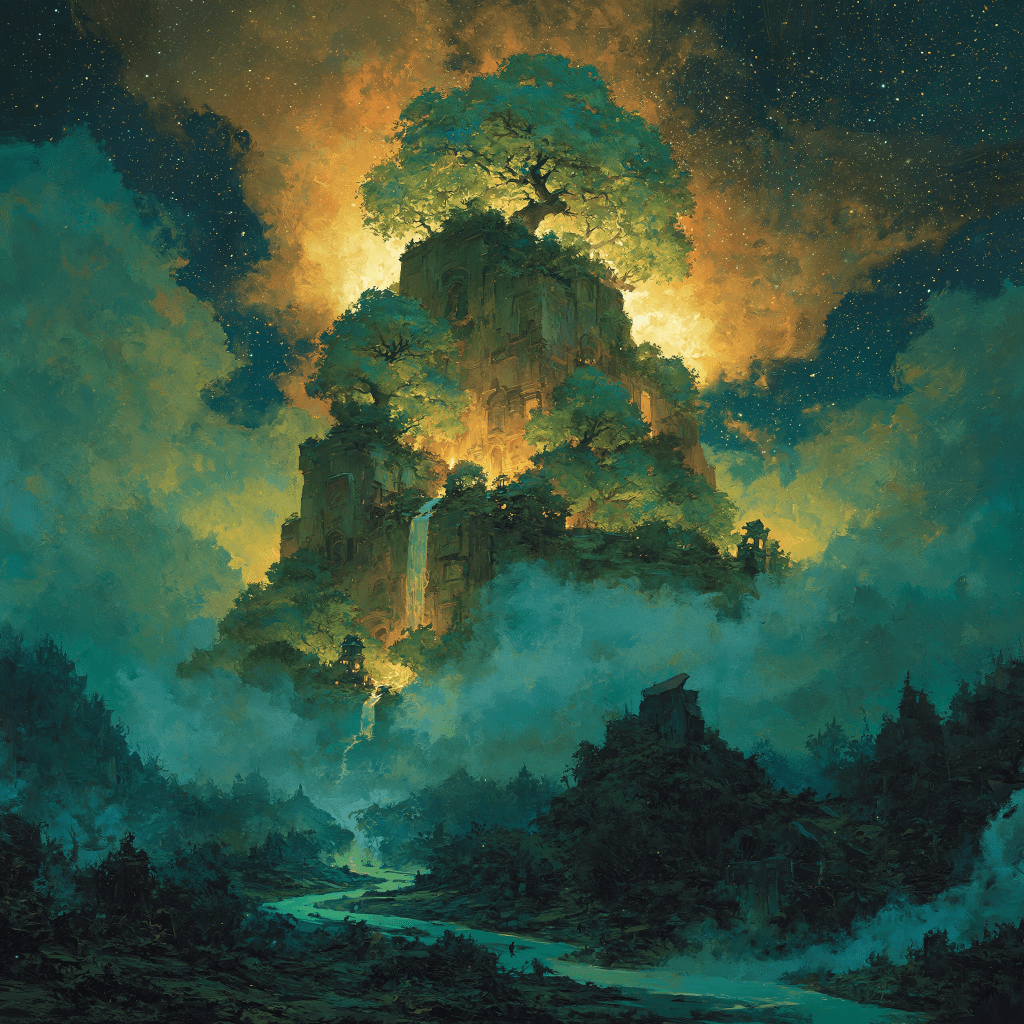
But one mountain often overlooked in Scripture is Mount Eden. This detail is pointed out by the prophet Ezekiel (Ezek 28:13–14) and is a logical conclusion when you recognize that God walked in Eden (Gen 3:8), that other divine beings could be found there (Gen 3:1, 24), and that Eden had to be higher terrain in order for a river to flow out of it to water the wider world (Gen 2:10–14).
The imagery of Eden as the cosmological mountain should help us see things more clearly. Eden is what Earth looks like when Heaven is cultivated on it. It is the spiritual realm of God made manifest in the material realm of humans. It is in the invisible made visible. It is what Earth looks like when God walks on it. It’s lush, fruitful, abundant, beautiful, ordered, peaceful, generous, full of wisdom, and very good. It’s the source of life, it’s life-giving, and it leads to immortal life.
Death, destruction, and sin are the chaotic forces that bring blights to such gardens. Disease overtakes the vegetation when humans partner with other little-g-gods to cultivate the earth with false wisdom. The kingdom of death is death-giving and leads to eternal death. The God of Life (Luke 20:38) is not part of this kingdom, nor will he allow such chaos to last forever. Death is other to God; contrary to God; the antithesis of God. In order for God to have the whole world, death must one day die completely (1 Cor 15:26), and so God will eventually end death (Rev 20:14).
Mount Eden is not just a place, but a vision and a mission. While the realms of Heaven and Earth have met like a sloppy wet kiss in Mount Eden to give birth to the crossbred realm of Hearth/Earven, the rest of Earth has not had the same experience. At the bottom of the mountain are the ingredients to cultivate more of Eden, but these wild areas have yet to receive God’s special touch in the same way. They are overgrown and chaotic. They require the touch of someone with God’s wisdom and gifting—someone who knows what to do with the ingredients to bring more of the life-giving realm of Heaven into the earth.
God was unwilling to settle for his will to be carried out on one mountaintop. He desired to cultivate the rest of the world into more of Eden, so that the whole planet might be touched by his presence. When God wants to fill a space with his will, he creates an image of himself and stations it there. In Heaven, he created divine beings to do this job (Gen 1:26). On Earth, he reached into the ground, pulled out some dirt, and breathed the life-giving Spirit of Heaven into it to create humans (Gen 2:7).
We exist to image God into the world in every conceivable way. We’ve always struggled to understand what the image looks like when lived out correctly, so God put on the earthly body of Jesus to show us (Col 1:15). When Heaven and Earth meet in a person, it looks like Christ. The same God who walked in Eden and shared wisdom with Adam and Eve is the same God who got up on a mountain and shared the wisdom of the beatitudes.
The Bible starts with a local garden and ends with a global garden, because the God of life is constantly life-ing the world through the lives of his life-giving imagers, who have been infused with his life-giving Spirit to cultivate abundant life. Imagers are to look to Jesus as Jesus shows us the way, the truth, and the life that he wants to instill into the Earth.


Leave a Reply