
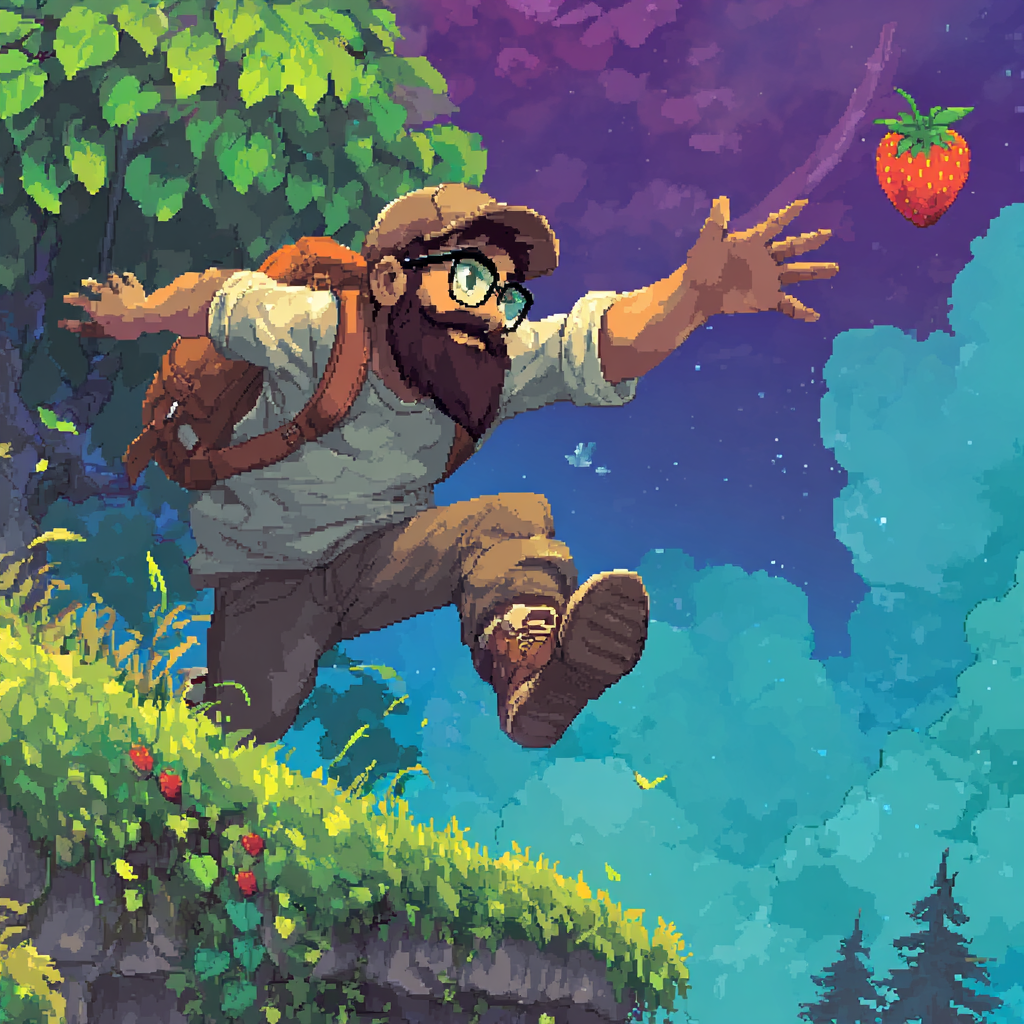
Precision platformers can be overwhelming to play. You really have to know your way around a video game controller, as every button held too long or too short can get you killed. You need to be able to change directions on a dime and land on the narrowest platforms before speedily jumping to the next one.
Afraid that Americans wouldn’t enjoy such challenges, Nintendo canned their release of the original Super Mario Bros 2 to the States. Although they released the game in Japan, they reworked a game called Doki Doki Panic into the version of Super Mario Bros. 2 that Americans are familiar with. (The Japanese version came to America later as Super Mario Bros: The Lost Levels.) But times have changed since then, and Americans seem to enjoy the challenge of video games, where they die hundreds of times before beating a level.
I’ve spent the last week revisiting one of my favorite precision platformers, Celeste. As I was playing through the B-Sides of Chapter 3 this morning (extra difficult bonus levels you can unlock), I found myself reflecting on what it might be like to speed-run this game.
The more I reflected on it, the more I realized something: I was actually expected to try to speed-run these levels. Every stage had enemy animations that always started in the same place when you respawned. They also synced up with each other to ensure that the level was moving at a perfect beat, no matter when you started moving. There were rhythms and patterns that could only be sensed if you were already moving forward from the moment you spawned. If you waited for even half a second, the whole rhythm would be thrown off.
Many of these levels could be beaten slowly and cautiously—what you could do in 8 seconds, you could also do in 58 seconds—but it is actually harder to do it slowly than to step into the relentless precision patterns that the game developers are hoping for you to catch onto. Gamers must have faith that quickly leaping and dashing will pay off, even when they can’t fully grasp the rhythm yet. And then, as they die over and over again, it all starts to fall into place. They have found the secrets of Celeste that they couldn’t see sense until they jumped off a cliff.
Those who master the full art of the speed-run can spot shortcuts that no one else can see. But once they’ve shown it to us, the hidden secrets of the game developers are revealed. There are walls we never had to climb. Platforms we never had to land on. Jumps and dashes we never had to make. With perfect timing, the enemy we were avoiding can become the boost we need to sail over obstacles we thought were mandatory to crawl under.
The best speedrunners become so familiar with the game and the controller that they can see beyond what even the game developers intended. They find shortcuts that were never supposed to be shortcuts and tricks that had never been thought of. They baffle us with their great expertise. They have become Celeste incarnate.
May this all serve as an analogy for our faith, where the Bible is our precision platformer, Jesus is our speed-running guide, and the Holy Spirit is our ability to incarnate it all for others to see and experience the deeper revelations that were once hidden.




Leave a comment